
Travel
Iceland
Westfjords · 18—25 JUN 2025
Under the Midnight Sun
I returned to Iceland in June 2025 for a week on the road. We landed in Reykjavík early in the morning, picked up a camper van and immediately started driving. For the next seven nights, it would be our home.
June meant almost constant daylight. Time quickly became difficult to measure — hikes ended around midnight, campsites were reached at two in the morning, and the road never really disappeared into darkness.
Our first day began slowly. After picking up the van, we stopped at hot pools beside a fjord before finding our campsite and sleeping for a few hours.
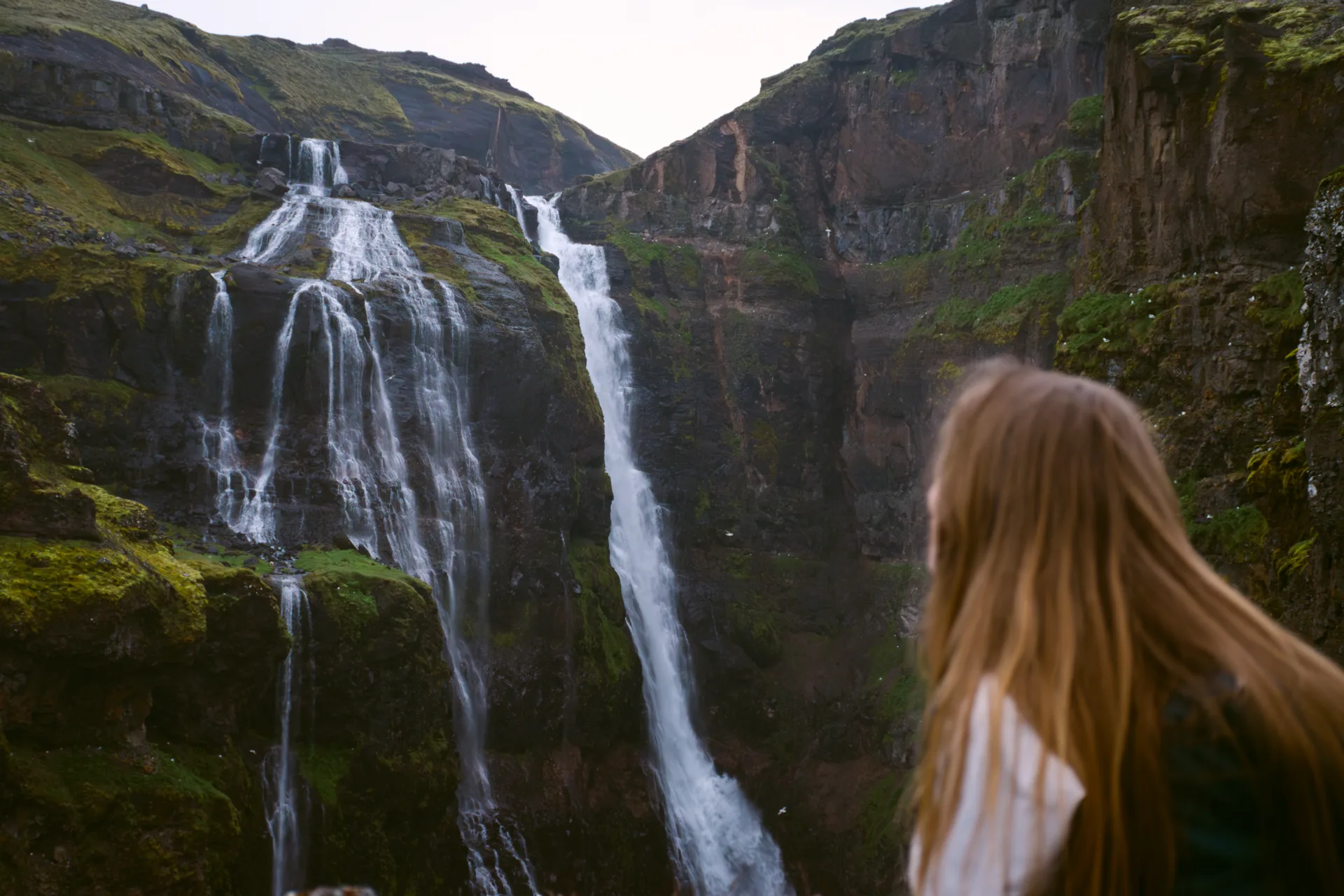
Later that evening, we started the hike toward Glymur. The trail followed a deep canyon, first crossing the river and then climbing high above it. Birds moved through the cliffs below us as the waterfall gradually came into view.
By the time we reached Glymur, it was almost midnight. We crossed the freezing river again above the falls and began the descent with the landscape still completely lit around us.
Into the Westfjords
The next morning, we turned north and began the long drive into the Westfjords. The roads became smaller, the distances between towns grew longer and eventually the pavement gave way to gravel.
Late that night, we reached Rauðasandur. It was close to two in the morning, but the sky was still bright. The van was covered in dust from the road and there was almost no one around us. That was the moment I realized the Westfjords were going to feel completely different from the Iceland I had known before.
Látrabjarg
The following day, we continued toward Látrabjarg. We spent several hours along the cliffs watching seabirds move between the grass, the rock faces and the ocean below. Puffins were everywhere, sometimes sitting only a few metres away. Razorbills and other seabirds shared the cliffs with them, constantly disappearing over the edge before returning from the sea.
It was one of those places where photography became secondary for a while. There was simply too much happening to stop watching.
Between Fjords
From there, we continued from one fjord to the next. White beaches and turquoise water appeared between dark mountains and steep cliffs — colours I had never expected to associate with Iceland.
Eventually, the road led us to Dynjandi. The waterfall revealed itself gradually as we climbed toward it, spreading across the mountainside in a series of wide cascades.
While photographing Dynjandi, I noticed an older woman who had just climbed the stairs toward the waterfall. Her name was Suzanne. She was eighty years old, from Australia, and travelling alone through Iceland for four months, simply taking the time to explore the country at her own pace. I asked if I could make her portrait. She smiled and agreed.
Beyond Ísafjörður
Near Ísafjörður, the landscape became quieter again. One evening, we walked through fields of lupins overlooking the fjord.
Across the water lay Hornstrandir, one of the most remote parts of Iceland. I had hoped to reach it during the trip, but our plans had come together too late to organize an expedition properly.
So for now, I could only look across the fjord. It immediately became somewhere I knew I would return to.
That night, we found a place to camp beside the sea. For most of the evening, everything was grey.
We drove along gravel roads between mountains, lupins, and sheep before finally stopping near the water. Then, shortly after one in the morning, the sky suddenly opened. The light spread across the fjord and stayed there far longer than a normal sunset. We watched birds moving along the shore and seals farther out in the water while the colours slowly changed around us.
This photograph was taken shortly after 1 a.m.
Wild Encounters
The next morning, we followed another empty road through the mountains before heading out onto the fjord. Several whales were feeding nearby, surfacing repeatedly around us.
On the road later that day, we came across an Arctic fox. I had seen several during the trip, but photographing one had become one of my goals for the week. This one stayed long enough for me to finally make the photograph I had been hoping for.
Later that day, we hiked into another valley outside Ísafjörður. The trail followed waterfalls through a landscape that seemed completely empty. We did not meet another person along the way — only a handful of sheep scattered across the hills.
It was one of the moments when the scale and isolation of the Westfjords became most obvious. It was also my birthday.
Heading South Again
The following morning, we began driving south again.
The landscapes changed gradually as we left the Westfjords behind and reached the Snæfellsnes Peninsula.
Icelandic horses appeared along the road, and eventually Kirkjufell came into view. I had seen the mountain countless times in photographs before travelling there, but standing in front of it felt completely different. The panorama remains one of my favourite photographs from the trip.
Warm Water, Cold Rain
Near the end of the trip, the weather finally turned cold and wet. We hiked into Reykjadalur, following steam through a landscape of exposed earth, green hills, and hot water flowing down the valley. Eventually, the trail reached the thermal river. After days of driving, hiking, and sleeping in the van, sitting in warm water while cold rain fell around us felt almost unreal. It also brought the trip full circle — from hot water beside a fjord on our first morning to a thermal river only a few days later.
After seven nights sleeping in the van, we returned to Reykjavík. Walking through the city again felt strangely calm after a week spent following gravel roads, fjords and the midnight sun.
This was my second trip to Iceland, but there is still an enormous part of the country I have not seen.
Iceland still feels unfinished to me.
Next time, I want to leave the roads behind and head into the Highlands.
Next story