
Travel
Azores
04 FEB 2025 — 10 AUG 2026
The trip began quietly on São Miguel: a coffee, a pastel de nata and a short rest before heading into the highlands.
By the time I reached the crater lake, I was inside the clouds. The water appeared and disappeared through the mist, and everything around me felt unusually still. It was my first real glimpse of how much of these islands is shaped by water, weather and vegetation.
Later that day, I followed a short trail down into a remote valley. On paper, the distance did not look like much. In reality, the steep descent, mud and exposed roots made it one of the more technical hikes I had done.
At the bottom, the forest opened onto a waterfall and a river coloured almost like rust. There was no one around. Only the sound of the water and small bubbles of gas breaking the surface.
THE WESTERN EDGE
The next morning, the western side of the island had almost completely disappeared into the clouds. I eventually made my way down to the village inside the crater and spent some time walking beside the lake before continuing toward the coast.
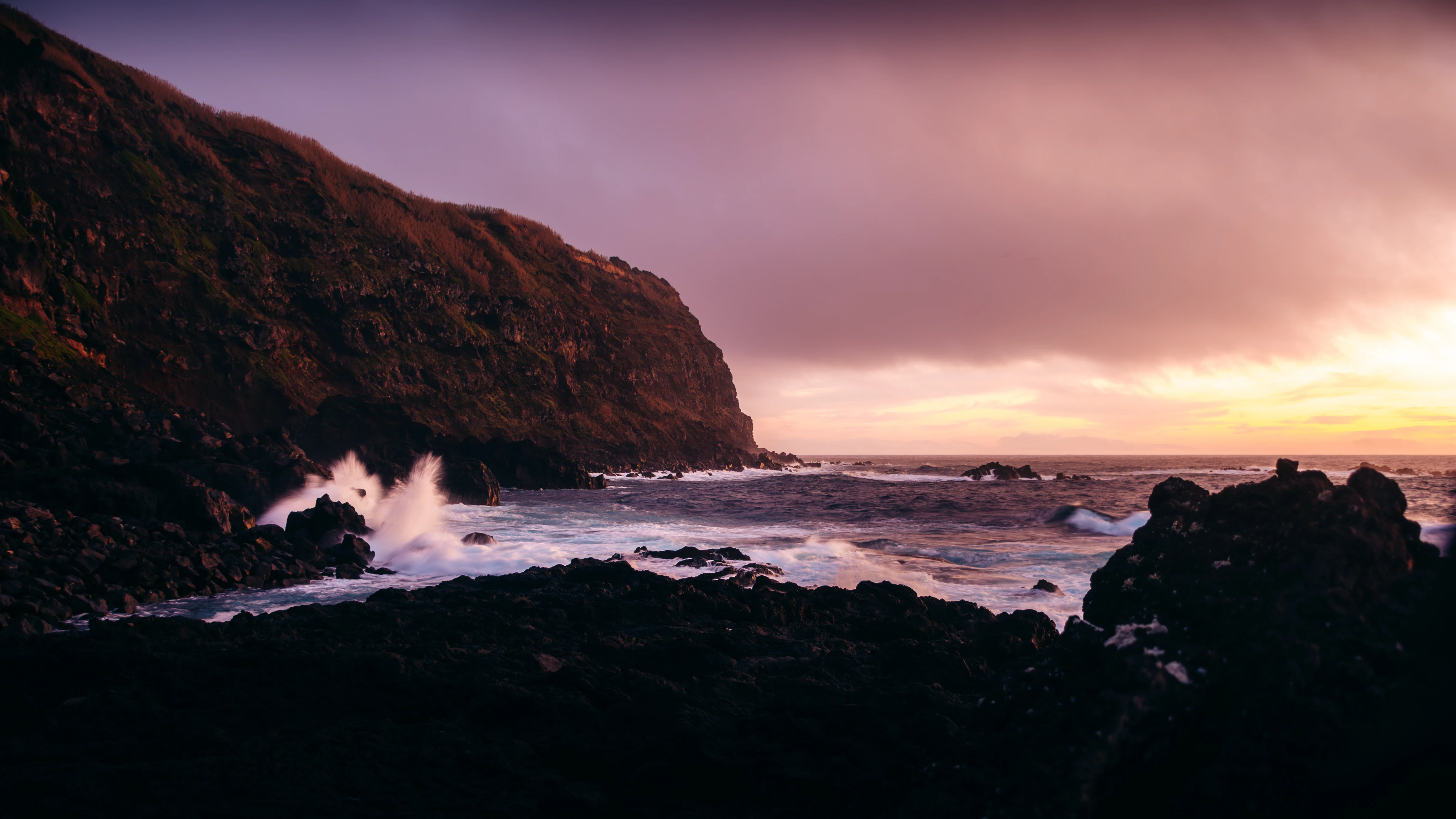
By late afternoon, I had reached the western edge of the island, where warm geothermal water meets the Atlantic. The tide was too high to swim safely, so I stayed on the cliffs instead. For more than an hour, I watched the waves break against the rocks as the sun slowly disappeared below the horizon. Once it was gone, I climbed back toward the lighthouse. The sky had turned violet and pink, and its beam cut directly across the horizon — a clear line between sea and sky
THROUGH THE GREEN
The following day took me back across São Miguel, first through its geothermal interior and then toward the south.
After stopping for a traditional meal, I continued along roads surrounded by dense vegetation. A few cows appeared along the way, standing above the valleys with a view that seemed almost too good for them.
The trail eventually passed through Sanguinho, a small abandoned village of stone houses and narrow streets left behind decades ago.
Beyond the village, the vegetation closed in again. The path continued deeper into the forest until it finally reached another waterfall hidden beneath the canopy.
By then, a pattern had started to emerge: on São Miguel, almost every road or trail seemed to eventually lead back to water.
WAITING FOR FLORES
A short flight on a Q400 carried me to the westernmost island in the archipelago, just ahead of a storm.
On the way to Cuada, I stopped at a viewpoint hoping the clouds would clear long enough to reveal the village and the waterfalls surrounding it.
A local man was there watching birds. We ended up waiting together for more than an hour, managing to communicate surprisingly well despite the language barrier.
Eventually, the cold and humidity won. I started walking back toward the car when I saw my new friend running out after me.
The clouds had opened.
For perhaps five minutes, the waterfalls and the village finally appeared before disappearing again into the weather.
By the time I reached the village, heavy rain had started. The instructions were clear: a major storm was moving through and I was not to leave.
From my small house, I could watch just how exposed Flores was to the Atlantic.
Waterfalls I had seen earlier were now being pushed back up the cliffs by the wind, seemingly defying gravity.
Then, against all expectations, the sky turned completely orange for a brief moment before becoming dark again for the stormy night ahead.
AFTER THE STORM
The wind was still there the following morning, but it was no longer enough to keep me inside.
I spent the day crossing Flores in almost every direction. I began below a huge wall of waterfalls, where the scale of the cliffs felt even more imposing from the valley floor.
From there, I continued upward through the island before eventually reaching the cliffs along the Atlantic.
What stayed with me most was the contrast between the scale of the landscape and the vulnerability of such a small island exposed in the middle of the ocean. Wind, water, and cloud seemed capable of changing it completely within minutes.
On my final day, I returned to the same place where my time on Flores had begun.
This time, I was alone and the sky was clear.
I stayed there for a while, looking across a landscape that had been almost completely hidden when I first arrived.
Before leaving, I set up the camera and made one of the few photographs of myself from the trip.
Next story